- 01
Separate a schema from its current rows.
- 02
Manipulate how primary and foreign keys decide a write.
- 03
See the six-lesson path into SQL results and transactions.
Database FoundationsMySQL 8.4.10
Learn database concepts and real execution as one path
Start with tables, rows, and keys, or move directly into real MySQL execution to trace indexes, joins, versions, locks, and waits.
New to databases
Start with Database Foundations
Before inspecting one engine, learn what schemas, current rows, keys, and constraints mean through the same customers and orders data.
FOUNDATION 01 · Available now
Learning path
Learn eight Labs as one three-stage path
Start with access and filtering, then follow physical work, row versions, locks, and waits. Each Lab shows the prerequisite and learning question before you open it.
STAGE 01
Read a query path
Build the core path from SQL clauses to access, filtering, joining, sorting, and result rows.
- LAB 01 Open lab
Order Search Execution
What row path does the same SQL create with a full scan versus a composite index?
Prerequisite Basic SELECT · JOIN · WHERE · ORDER BY · LIMITWhat you will trace
Compare the table, index, filter, join, sort, and result flow produced by the same order query with a full scan and a composite index.
- LAB 02 Open lab
Composite Index Anatomy
How does index column order change the equality prefix, first range, ICP, and base-row lookup?
Prerequisite LAB 01 · access path, filter, sortWhat you will trace
Switch among three index orders and follow the equality prefix, first range, ICP, base-row lookup, and index-only projection through real plans and rows.
- LAB 03 Open lab
Cardinality & Histograms
Why can a changed estimate alter optimizer decisions when the result rows stay the same?
Prerequisite LAB 01 · rows, filtered, filesortWhat you will trace
Compare how absent, fresh, and stale histograms change filtered and estimated Filter rows over identical data, grounded in captured buckets, plans, and 128 actual rows.
STAGE 02
Follow operators and physical work
Connect join algorithms, internal temporary work, and secondary-to-clustered lookup to exact rows and pages.
- LAB 04 Open lab
Nested Loop vs Hash Join
In what order do Hash Join build/probe and Nested Loop outer/inner lookup encounter rows?
Prerequisite LAB 01 · join row flowWhat you will trace
Compare Hash Join build/probe flow with Indexed Nested Loop outer/inner lookups over identical SQL and fixture data, grounded in native plans, actual rows and loops, and exact matched pairs.
- LAB 05 Open lab
Internal Temporary Work
How do GROUP BY rows pass through temporary work, filesort, and memory or disk profiles before LIMIT returns 100 rows?
Prerequisite LAB 03 · GROUP BY, sort, LIMITWhat you will trace
Trace the internal temporary rows, filesort, and LIMIT boundary produced by one GROUP BY query across RAM, mmap overflow, and InnoDB on-disk profiles, grounded in exact rows and captured memory.
- LAB 06 Open lab
Secondary Index & Buffer Pool
Which clustered row and Buffer Pool page does a primary key carried by a secondary entry reach?
Prerequisite LAB 02 · secondary index, base-row lookupWhat you will trace
Trace one non-covering range query from a secondary entry and carried primary key to its clustered row, then compare captured cold and warm Buffer Pool pages and counters.
STAGE 03
Follow versions and waits
Connect transaction snapshots, row versions, record/gap locks, waits, and COMMIT.
- LAB 07 Open lab
MVCC Consistent Read
Which row version does the same SELECT read under each isolation level and COMMIT point?
Prerequisite LAB 06 · clustered row · transaction basicsWhat you will trace
Compare which row versions the same secondary-index SELECT reads before and after the writer COMMIT under REPEATABLE READ and READ COMMITTED, grounded in transactions, an undo-traversal Model, and captured results.
- LAB 08 Open lab
Locking Read: FOR UPDATE and Next-Key Lock
Which records and gaps does a FOR UPDATE range lock, who waits, and what resumes after COMMIT?
Prerequisite LAB 07 · snapshot, COMMIT, row versionWhat you will trace
Compare whether Session A's SELECT makes Session B's INSERT and Session C's UPDATE wait. The same WHERE clause is replayed as a plain SELECT, REPEATABLE READ + FOR UPDATE, and READ COMMITTED + FOR UPDATE.
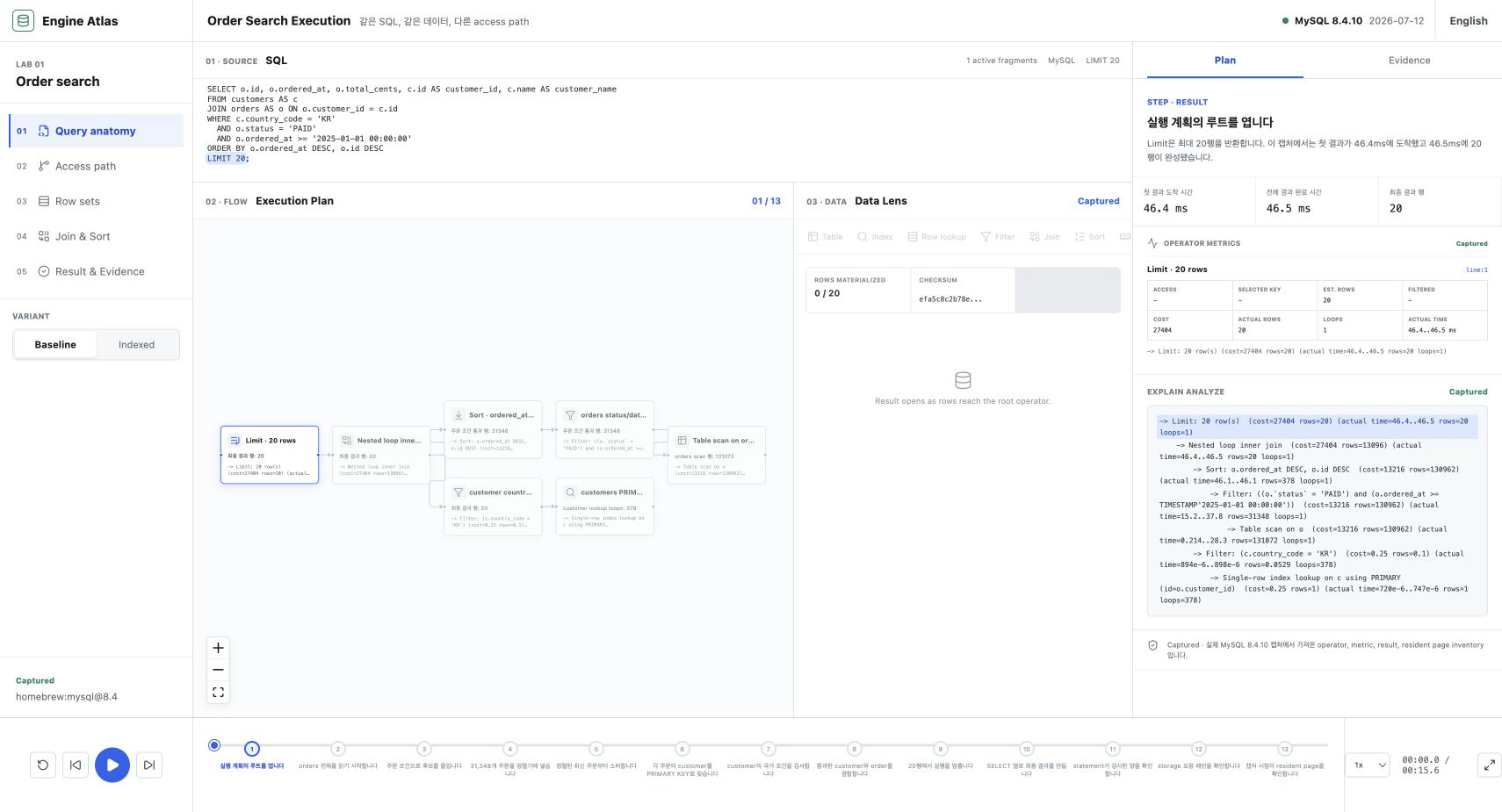
Compare how the same SQL produces a full scan and a composite-index access path, grounded in actual rows.
Workbench
Four surfaces point to the same execution step
- SQL
The active clause and predicate
- Execution Plan
The active operator, access type, selected key, rows, and cost
- Data Lens
Table scans, index candidates, filters, joins, sorting, and result rows
- Plan & Evidence
The raw plan line and source behind each metric
Evidence methodology
Keep engine evidence separate from explanatory Models
Every visible value is labeled by where it comes from.
- Captured
- EXPLAIN, Performance Schema, Handler counters, and results from MySQL 8.4.10
- Derived · fixture
- Exact row sets calculated by applying the same predicate to the fixed fixture
- Logical model
- A B-tree teaching model built from the index definition and candidate keys